
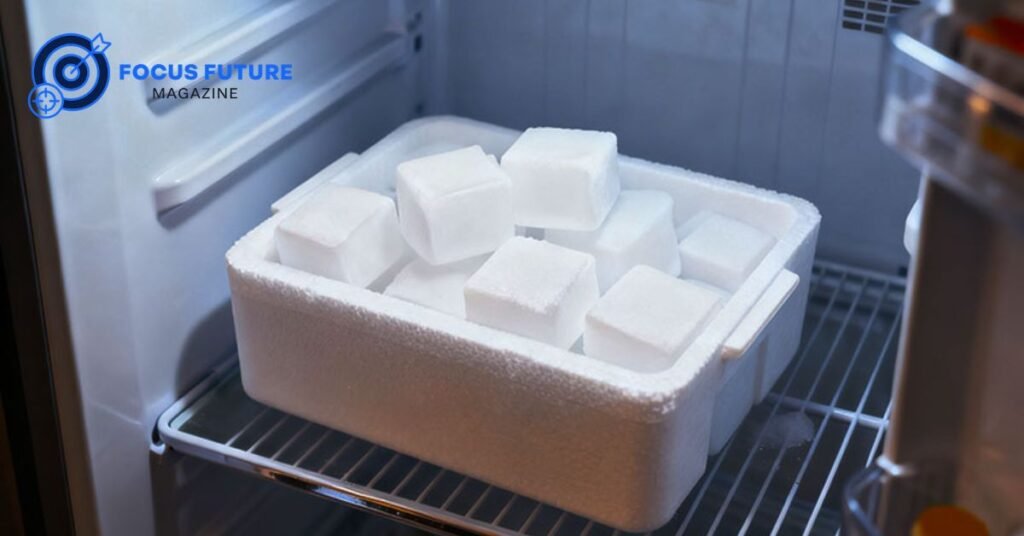
How long does dry ice last in a freezer? The honest answer is: not as long as most people expect, and it shouldn’t be stored there in the first place. Dry ice is much colder than a normal freezer, so it keeps turning into gas the whole time it sits inside one. A typical planning number is 5 to 10 pounds lost every 24 hours in a good insulated container. For emergencies, the FDA says 50 pounds of dry ice can keep a fully stocked 18-cubic-foot freezer cold for about two days, but that’s about protecting your food during a power outage, not a rule about how long the dry ice itself survives.
Those are two different questions, and this guide answers both of them clearly — including exactly how long dry ice last in each situation.
What Is Dry Ice?
Dry ice is frozen carbon dioxide, or CO₂, not frozen water. It looks like white ice, but it behaves completely differently once it starts to warm up.
Regular ice melts into a puddle. Dry ice does not. Instead, it turns straight into gas, skipping the liquid stage entirely. That’s the biggest thing to understand before you buy or store any of it.
Because of this, dry ice can’t just sit in a container and stay solid the way regular ice cubes do in your freezer’s ice bin. It is always shrinking, a little at a time, from the moment it’s made — which is exactly why knowing how long dry ice last matters before you buy it.
Why Dry Ice Sublimates
Dry ice sublimates because of temperature and pressure. At normal air pressure, solid CO₂ has no stable liquid form, so warming it causes it to skip straight to gas.
This process is called sublimation, and it happens continuously as long as the dry ice is warmer than its surface temperature of roughly -109°F (-78°C). Since almost everywhere on Earth, including inside your freezer, is warmer than that, the sublimation never really stops.
The rate just changes depending on the surroundings. Cold air slows it down. Warm air, sunlight, and open exposure speed it up.
How Long Does Dry Ice Last?
Dry ice generally lasts anywhere from a few hours in open air to a few days inside a well-insulated container, depending on the amount and packaging. There is no single fixed number.
In a typical insulated cooler, a common planning estimate is 5 to 10 pounds of loss per 24 hours. Leave dry ice sitting out on a counter in open air, and it may disappear in just a few hours.
The biggest factors are the weight of the ice, how it’s packaged, the size of the pieces, and the surrounding temperature. A 20-pound block in a heavy-duty cooler will always outlast 5 pounds of pellets left in a paper bag, which shows how much packaging alone changes how long dry ice last.
How Long Does Dry Ice Last in a Freezer?
Dry ice does not last indefinitely in a household freezer. It keeps sublimating because even a very cold freezer is nowhere near as cold as dry ice itself.
Household freezers typically run around 0°F, while dry ice sits at about -109°F. That’s a difference of more than 100 degrees, so the dry ice is still constantly losing mass to the warmer air around it, just more slowly than it would at room temperature.
There is no universal number of hours or days that applies to every freezer, since it depends on the amount of dry ice, how it’s packaged, and how often the freezer door opens. What’s more important is understanding that a freezer slows sublimation, but does not stop it, and safety authorities generally advise against using a freezer this way at all.
Why a Household Freezer Does Not Preserve Dry Ice
A household freezer cannot fully preserve dry ice because its internal temperature is still dramatically warmer than the surface of dry ice. Freezers are built to keep food cold, not to match the extreme cold of solid CO₂.
Cornell’s environmental health and safety guidance is direct about this: dry ice should not be placed in a refrigerator, freezer, or any other enclosed appliance. Two things happen when you do this. First, CO₂ gas can build up inside the sealed space. Second, the extreme cold can damage a freezer’s thermostat or other internal components.
This is worth repeating because so much confusion exists around it: putting dry ice in your freezer will not preserve the dry ice for long, and it can create a safety hazard while doing very little good.
Dry-Ice Duration by Storage Environment
Here’s how different storage conditions compare, based on common planning estimates:
| Environment | Planning Estimate | Main Variables |
|---|---|---|
| Open air, room temperature | Often just a few hours | Block size, air movement, ambient temperature |
| Typical insulated cooler | About 5–10 lb per 24 hours | Insulation quality, lid openings, block size |
| High-quality insulated container | Potentially longer than a standard cooler | Container design, thermal mass |
| Household freezer | No reliable universal duration; not recommended | Appliance temperature, ventilation, contact with components |
| Emergency freezer outage | 50 lb keeps a full 18-cu-ft freezer cold for about 2 days | Freezer volume, food load, door openings |
Does Dry Ice Last Longer in a Freezer?
Yes, dry ice will sublimate somewhat more slowly inside a freezer than it would sitting out at room temperature, simply because the air around it is colder. But “somewhat slower” is not the same as “preserved.”
The freezer’s cold air reduces the temperature gap, which reduces the rate of sublimation to some degree. However, because storing dry ice in an enclosed freezer isn’t recommended for safety reasons, this small benefit isn’t worth the risk.
If your real goal is making dry ice last as long as possible, a good insulated cooler with a vented lid will usually serve you better and more safely than tucking it into your freezer.
Dry Ice for Freezer Power Outages
During a power outage, dry ice can be a genuinely useful tool for keeping your food frozen, as long as you understand the right amounts and precautions. This is one of the main reasons people search for this topic in the first place.
The FDA’s guidance is specific: about 50 pounds of dry ice can keep a fully stocked 18-cubic-foot freezer cold for roughly two days, assuming the door stays closed and the ice is placed correctly. A half-full freezer will lose its cold faster than a full one, since a full freezer holds more cold mass overall.
During an outage, keep these points in mind:
- Keep the freezer door shut as much as possible.
- Place dry ice on top of frozen items, not underneath them, since cold air sinks.
- Never let dry ice touch food directly for long periods.
- Check food temperature with a thermometer once power is restored, rather than judging by look or feel.
How Much Dry Ice Does a Freezer Need?
The amount of dry ice a freezer needs depends mainly on its size and how full it already is. This is where a lot of guesswork happens, so it helps to use the FDA’s benchmark as your starting point.
For an 18-cubic-foot freezer that’s fully stocked, plan for about 50 pounds of dry ice to maintain safe temperatures for roughly two days. If your freezer is smaller or larger, scale the amount accordingly, since bigger freezers need more ice to fill and cool the extra air space.
A freezer that’s only half full will need dry ice sooner and won’t hold cold air as long as a packed one, because there’s less frozen mass acting as a buffer. In short, how long dry ice last inside your freezer depends heavily on how full it already is.
FDA Guidance for an 18-Cubic-Foot Freezer
The FDA’s specific guidance is one of the most useful numbers available for anyone planning ahead of a storm or outage: 50 pounds of dry ice can keep a fully stocked 18-cubic-foot freezer cold for about two days.
This figure assumes normal conditions — the freezer door stays closed, the dry ice is placed properly, and the unit was already cold before the power went out. Opening the door frequently, or starting with a freezer that wasn’t fully cold, will shorten this window.
It’s a helpful planning benchmark, but it’s not a guarantee. Treat it as a solid starting estimate rather than an exact countdown.
Factors That Affect Dry-Ice Duration
Several variables determine exactly how fast your dry ice disappears, and understanding them helps you plan how long dry ice last in your specific situation.
Amount and block size. Larger, solid blocks last longer than the same weight broken into smaller pieces, because less surface area is exposed to warm air.
Pellets versus blocks. Pellets sublimate faster than blocks because of their higher surface-area-to-weight ratio. If you need long-lasting cooling, a block is usually the better choice.
Insulation and airflow. A well-insulated, vented container slows the loss significantly compared to loose wrapping or an open bag.
Temperature and surface area. Warmer surroundings and more exposed surface both speed up sublimation.
Frequency of opening. Every time you open a cooler or freezer, warm air rushes in and cold gas escapes, so opening it less often preserves the ice longer.
How to Make Dry Ice Last Longer
If you want to stretch your dry ice supply, a few simple habits make a real difference.
- Buy it as close to the time you’ll use it as possible, since sublimation starts right away.
- Choose blocks over pellets when you need it to last.
- Use a well-insulated container with a vented lid, not an airtight seal.
- Keep the container in a shaded, cool spot, away from direct sunlight or heat.
- Open the container as infrequently as you can manage.
- Avoid breaking the ice into smaller pieces before you need to.
Can Dry Ice Damage a Freezer?
Yes, dry ice can potentially damage a freezer, which is one more reason not to use it as everyday storage. Safety guidance from Cornell warns that the extreme cold of dry ice may damage a freezer’s thermostat or other internal components.
Beyond mechanical damage, there’s also a gas-buildup concern. In an enclosed space like a sealed freezer, CO₂ gas released during sublimation has nowhere to go, which raises the risk of dangerous gas concentration in a small, closed area.
For these reasons, dry ice should only be used inside a freezer briefly and carefully during an emergency, following the placement and door-closing guidance above, rather than as a routine storage practice.
Dry-Ice Safety Hazards
Dry ice comes with real hazards, and taking them seriously matters more than getting the exact duration numbers right.
Frostbite and cold injury. Dry ice’s surface temperature is about -109°F, cold enough to cause severe skin injury on contact. Always use dry, loose-fitting insulated gloves and eye protection when handling it.
Carbon-dioxide buildup. CO₂ is colorless and odorless, so you can’t rely on smell to detect it. In enclosed or poorly ventilated spaces, like walk-in freezers, vehicles, or small rooms, it can build up to unsafe levels. OSHA has specifically flagged dry-ice storage in walk-in freezers as an asphyxiation hazard.
Pressure explosions. As dry ice sublimates, it constantly releases gas. If it’s sealed inside an airtight container, pressure builds until the container ruptures. Never seal dry ice in a jar, bottle, or airtight cooler.
If you ever smell nothing unusual but start feeling dizzy, get a headache, or have trouble breathing near dry ice, leave the area immediately and get fresh air. No estimate of how long dry ice last is worth risking your safety over.
Can You Put Dry Ice in an Airtight Container?
No, dry ice should never go in an airtight or sealed container. As it sublimates, it constantly releases CO₂ gas, and a sealed container gives that gas nowhere to escape.
Pressure builds up steadily inside the sealed space until the container can no longer hold it, which can cause it to burst or rupture without much warning. This is dangerous both from the pressure itself and from the sudden release of gas.
Always use a container designed to vent, such as a cooler with a loose-fitting lid, rather than anything with a tight or locking seal.
How to Handle Dry Ice Safely
Handling dry ice correctly isn’t complicated, but it does require some basic precautions every time.
- Wear dry, loose-fitting insulated gloves, never bare hands or thin latex gloves.
- Use tongs or a scoop when possible, rather than direct hand contact.
- Wear eye protection, since flying chips can cause eye injury.
- Only use dry ice in well-ventilated areas, avoiding small enclosed spaces like elevators or car trunks during long drives.
- Keep it away from children and pets.
- Never place it directly against bare skin, even briefly.
How to Dispose of Leftover Dry Ice
The safest way to get rid of leftover dry ice is to let it sublimate on its own in a secure, well-ventilated area. Do not try to speed this up by breaking it apart carelessly or forcing it into a small space.
Never place dry ice in a regular trash can, sink, toilet, or floor drain. Sudden gas release in these enclosed spots can cause pressure damage or create a localized gas hazard.
Instead, set it in a compatible, vented container somewhere with good airflow, away from foot traffic, and let nature take its course. How long dry ice last during disposal depends on the leftover amount, but it typically disappears completely within a day or two.
Dry-Ice Duration Table
| Form | Expected Behavior |
|---|---|
| Large block | Lasts longer due to less exposed surface area |
| Thick slab | Good for prolonged cooling |
| Pellets | Sublimate faster due to high surface area |
| Small pieces | Convenient but shorter-lived |
| Powder or snow | Very rapid sublimation |
Dry-Ice Power-Outage Checklist
- Estimate your freezer’s size in cubic feet.
- Plan for roughly 50 lb per 18 cubic feet of fully stocked freezer space.
- Buy dry ice as close to the outage as possible.
- Wear gloves and eye protection when placing it.
- Put dry ice on top of food, not underneath.
- Keep the freezer door closed as much as possible.
- Check food temperature with a thermometer once power returns.
- Let any unused dry ice sublimate safely outdoors or in a ventilated space.
FAQs
Does dry ice expire? Not in the traditional sense, but it is always sublimating from the moment it’s made, so it effectively “runs out” rather than expiring on a shelf.
Can dry ice touch food? Direct, prolonged contact isn’t ideal. It’s better to place a barrier, like cardboard or a towel, between dry ice and food during storage.
How long does dry ice last in a cooler? A common planning estimate is 5 to 10 pounds of loss every 24 hours in a typical insulated cooler, though block size and insulation quality change this.
Can dry ice be reused? No. Once it sublimates into gas, it’s gone. There’s no way to refreeze it back into solid form at home.
Is dry ice safe indoors? It’s safe in small quantities in a well-ventilated room, but should be avoided in small, enclosed, poorly ventilated spaces where CO₂ gas could build up.
How much dry ice should I buy? For a fully stocked 18-cubic-foot freezer during an outage, plan for about 50 pounds to last roughly two days. Scale up or down based on your freezer’s actual size and how full it is.
Conclusion
Dry ice never stops sublimating inside a freezer, it just does it a little more slowly than it would in open air. A household freezer isn’t cold enough to preserve it, and safety authorities like Cornell actively advise against storing it there because of CO₂ buildup and possible appliance damage. For everyday cooling, a well-insulated, vented cooler is the safer and more effective choice. For a power outage, the FDA’s benchmark of 50 pounds keeping a fully stocked 18-cubic-foot freezer cold for about two days is a solid planning number to work from. Whichever way you use it, treat dry ice with respect: wear gloves, keep it ventilated, never seal it airtight, and let leftovers sublimate safely rather than forcing disposal. Once you understand how long dry ice last in each setting, you can plan confidently for coolers, freezers, and outages alike.