
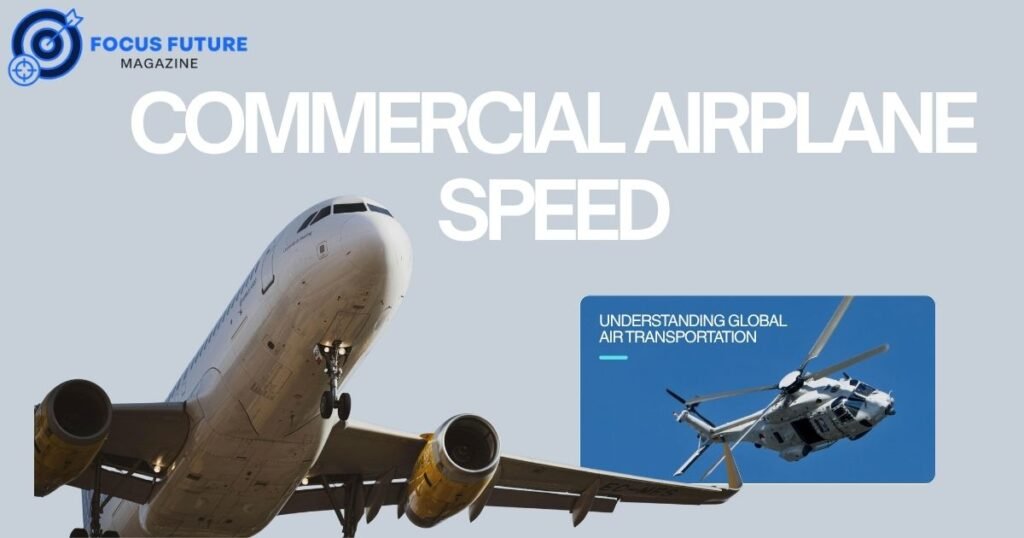
Commercial airplane speed usually falls between Mach 0.78 and Mach 0.85, or roughly 500 to 650 mph, once a jet reaches cruising altitude. That range covers almost every modern passenger jet in the sky today, from short-haul narrow-body planes to long-haul wide-body jets. The exact number depends on the aircraft model, its altitude, the weather, and even which direction it is flying.
What Is Commercial Airplane Speed?
Commercial airplane speed is not one fixed number. It changes based on the aircraft, its flight phase, and outside conditions like wind and temperature.
Pilots and engineers describe speed in several ways: miles per hour, kilometers per hour, knots, and Mach number. Mach compares the plane’s speed to the local speed of sound, which itself changes with altitude and temperature. This is why airlines rarely give one single “correct” speed for a plane.
A plane’s speed also depends on what stage of flight it’s in. Taxiing, climbing, cruising, and landing all happen at very different speeds. Weight, wind, and route length matter too.
Average Commercial Airplane Speed
Most modern jetliners cruise at approximately Mach 0.78 to Mach 0.85. In practical terms, that’s about 515 to 650 mph, or 830 to 1,050 km/h.
Smaller narrow-body jets like the Airbus A320neo tend to sit near the lower end of that range, cruising around Mach 0.78. Larger wide-body jets built for long routes, such as the Airbus A350, cruise faster, closer to Mach 0.85. Regional turboprops fly slower than jet-powered aircraft of any size.
It helps to remember that “average speed” is really a cruise target, not a hard limit. Airlines pick a cruise speed that balances travel time against fuel burn.
Commercial Airplane Speed in MPH, KM/H, Knots, and Mach
Aviation uses Mach and knots more than mph, because Mach reflects real air conditions and knots are tied to nautical miles used in flight planning.
| Unit | Typical Cruise Value |
| Mach | 0.78–0.85 |
| Miles per hour | ~515–650 mph |
| Kilometers per hour | ~830–1,050 km/h |
| Knots (true airspeed) | ~440–490 knots |
These conversions are approximate. A Mach 0.8 speed does not equal the same mph at every altitude, since the speed of sound depends on air temperature, which changes as a plane climbs.
How Fast Do Planes Fly at Cruising Altitude?
At cruising altitude, planes fly faster than at any other point in the flight. This is where jets reach their Mach 0.78–0.85 range, usually between 30,000 and 40,000 feet.
Thinner air at high altitude creates less drag, letting the aircraft move efficiently at higher speeds while burning less fuel per mile. This is also why Mach number becomes the more useful measurement up there, rather than mph.
Below 10,000 feet, U.S. airspace rules generally cap indicated airspeed at 250 knots unless an exception applies. That rule doesn’t apply once a plane climbs above that altitude.
Commercial Aircraft Speed by Type
Different categories of commercial aircraft cruise at noticeably different speeds. Knowing the category helps make sense of any specific speed number you see online.
Regional Turboprops
Turboprops generally cruise slower than jet aircraft. They’re used on shorter regional routes where top speed matters less than efficiency at lower altitudes.
Regional Jets
Regional jets cruise in a similar subsonic range to larger jets but typically stay below the cruise speeds of big wide-body aircraft.
Narrow-Body Passenger Jets
Narrow-body jets, like the A320neo family, commonly cruise around Mach 0.78 to 0.82.
Wide-Body Passenger Jets
Wide-body aircraft, built for long-haul international routes, often cruise faster — typically Mach 0.84 to 0.85.
Cruise Speed of Popular Commercial Airplanes
Manufacturer data gives the clearest picture of real cruise speeds, since third-party sites often mix up cruise speed with maximum speed.
| Aircraft | Cruise/Max Speed |
| Airbus A220 | Mach 0.82 max cruise; 541 mph / 871 km/h |
| Airbus A320neo | Mach 0.78 cruise; Mach 0.82 max operating |
| Boeing 737 MAX | Similar narrow-body range near Mach 0.78–0.82 |
| Embraer E195-E2 | Mach 0.82 max cruise |
| Boeing 777 | Mach 0.84 |
| Boeing 787 | Similar wide-body range near Mach 0.84–0.85 |
| Airbus A350 | Mach 0.85 |
Airbus A220
Airbus lists the A220’s maximum cruise speed at Mach 0.82, or about 541 mph.
Airbus A320neo
The A320neo cruises around Mach 0.78, with a maximum operating Mach near 0.82.
Boeing 737 MAX
The 737 MAX falls in a comparable narrow-body cruise range to the A320neo family.
Embraer E195-E2
Embraer lists this regional jet’s maximum cruise speed at Mach 0.82.
Boeing 777
Boeing specifies a Mach 0.84 cruise speed for the 777.
Boeing 787
The 787 flies in a similar wide-body speed class to the 777 and A350.
Airbus A350
The A350-900 cruises at Mach 0.85, among the fastest of today’s widely used passenger jets.
How Fast Do Airplanes Fly During Takeoff and Landing?
Airplanes fly much slower during takeoff and landing than at cruise. Takeoff speed depends on aircraft weight, runway length, and weather, while landing speed depends on aircraft configuration and approach conditions.
During initial climb, noise procedures and lower-altitude airspace limits often keep speeds down. As the aircraft climbs past 10,000 feet, it gradually shifts from indicated-speed targets toward Mach-based targets. Descent and approach speeds are carefully managed by air traffic control and aircraft limits, right up until the landing roll and deceleration on the runway.
Airspeed, Groundspeed, and True Airspeed
Airspeed and groundspeed are not the same thing. Airspeed measures how fast a plane moves through the surrounding air, while groundspeed measures how fast it moves over the ground.
| Term | Meaning |
| IAS | Speed shown to the pilot; corrected later for accuracy |
| CAS | IAS adjusted for instrument and position errors |
| TAS | True speed through the surrounding air |
| Groundspeed | Speed relative to the Earth’s surface |
| Mach | Speed relative to the local speed of sound |
Why Does Wind Change Flight Speed?
Wind changes groundspeed, not necessarily airspeed. A tailwind pushes the plane along faster relative to the ground, while a headwind slows it down — even though the plane’s speed through the air may barely change. This is also why the same flight often takes longer in one direction than the other.
Why Do Commercial Airplanes Fly Below Mach 1?
Commercial airplanes generally fly below Mach 1 because flying near or above the speed of sound sharply increases drag, fuel burn, and structural stress. Staying in the Mach 0.78–0.85 range gives airlines the best balance of speed and efficiency.
What Is the 250-Knot Speed Limit?
In U.S. airspace, aircraft generally cannot exceed 250 knots indicated airspeed below 10,000 feet, with some exceptions. This rule exists for safety and separation, not fuel efficiency.
Cruise Speed Versus Maximum Operating Speed
Cruise speed is what airlines normally use in everyday operations. Maximum operating speed, often shown as MMO or VMO, is a certified upper limit that aircraft aren’t meant to fly at routinely.
Fastest Commercial Passenger Aircraft in History
How Fast Was Concorde?
Concorde cruised at roughly Mach 2 — about twice the speed of sound — making it by far the fastest passenger aircraft ever to fly commercially. It entered regular service in 1976 with British Airways and Air France, but commercial passenger service ended in 2003.
Are Supersonic Commercial Airplanes Returning?
No scheduled commercial passenger service currently flies at supersonic speed. Research is underway, but nothing has replaced Concorde for paying passengers yet.
What Is NASA’s X-59?
NASA’s X-59 is an experimental research aircraft, not a passenger airliner. It’s part of NASA’s Quesst mission, aimed at gathering data to support future rules for quieter supersonic flight over land. NASA reported the X-59 exceeded the speed of sound for the first time on June 5, 2026, and its planned mission speed is around Mach 1.4, or about 925 mph.
What Factors Affect Commercial Airplane Speed?
Several factors combine to determine how fast a specific flight actually moves:
- Aircraft model and design
- Takeoff weight
- Altitude and air density
- Outside air temperature
- Wind direction and strength
- Flight phase (climb, cruise, descent)
- Air traffic control restrictions
No single factor tells the whole story — they all interact together on every flight.
How Does Airplane Speed Affect Flight Time?
Speed alone doesn’t determine how long a flight takes. Total flight time also depends on route distance, wind conditions, taxiing, climb and descent time, and any air traffic delays.
A flight with a strong tailwind can arrive noticeably earlier than the same route flown against the wind, even with identical cruise speeds. This is why airlines plan westbound and eastbound flights differently, especially on long-haul routes affected by jet streams.
Common Commercial Airplane Speed Mistakes
Many articles and sites make the same errors when discussing airplane speed:
- Stating one fixed mph number for all commercial planes
- Calling Mach 0.85 a “maximum speed” when it’s a cruise value
- Mixing up knots with mph without converting
- Applying the 250-knot rule to all altitudes
- Comparing turboprops directly with wide-body jets
- Listing Concorde as an active commercial aircraft
- Describing NASA’s X-59 as a passenger airliner
Avoiding these mix-ups gives a much clearer, more accurate picture of how fast commercial planes actually fly.
FAQs
How fast do commercial airplanes fly? Most modern passenger jets cruise around Mach 0.78 to 0.85, or roughly 500 to 650 mph, depending on the aircraft and altitude.
What is the fastest passenger airplane? Concorde was the fastest, cruising at about Mach 2, but it was retired from commercial service in 2003. Among current jets, wide-body aircraft like the Airbus A350 (Mach 0.85) are near the top of the range.
Does a bigger airplane fly faster? Not necessarily. Wide-body jets often have higher published cruise speeds than narrow-body jets, but size alone doesn’t decide speed — engine design, wings, and operating targets matter more.
Can a commercial airplane break the sound barrier? No scheduled commercial passenger service currently flies faster than sound. NASA’s experimental X-59 has exceeded Mach 1, but it is a research aircraft, not an airliner.
Does a tailwind make a plane fly faster? A tailwind increases groundspeed, meaning the plane moves faster relative to the ground, even though its airspeed through the surrounding air may stay about the same.
How fast does a Boeing 737 fly? The Boeing 737 MAX cruises in a similar narrow-body range to the Airbus A320neo, generally around Mach 0.78 to 0.82.
How fast does an Airbus A320 fly? The Airbus A320neo cruises around Mach 0.78, with a maximum operating Mach of about 0.82.
How fast do planes fly during landing? Landing speed is much lower than cruise speed and depends on aircraft weight, configuration, and approach conditions, slowing further during the landing roll after touchdown.