
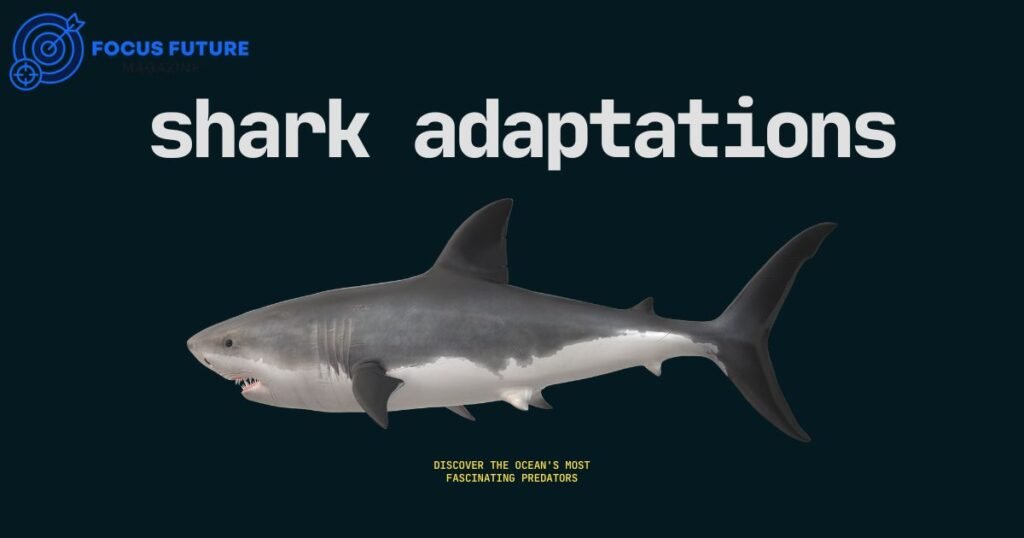
Shark adaptations are inherited traits that help sharks survive and reproduce in the ocean. They include a light skeleton, slick skin, sharp senses, and clever ways to breathe, float, and hunt. No single trait does the job. Sharks survive because many traits work together.
There are more than 500 shark species. That is why their adaptations vary so much by habitat, diet, and size.
What Are Shark Adaptations?
A shark adaptation is a body feature or behavior, passed down through generations, that improves survival in a certain environment. It can be physical, sensory, physiological, behavioral, or reproductive.
Adaptations are not choices. An individual shark does not change its body on purpose. Traits become common over many generations because sharks that have them survive and breed more often.
This is different from acclimatization, where one animal adjusts to its surroundings during its lifetime. It is also different from behavior. Migration, for example, may mix inherited habits with learned location cues.
How Is a Shark’s Body Adapted?
A shark’s body is built to be light, smooth, and fast. Four features do most of the work.
Cartilaginous Skeleton
Sharks have cartilage instead of true bone. Cartilage is lighter and more flexible, so it lowers body weight and helps with efficient swimming. It is not simply “better” than bone, though. It is one trade-off among many.
Streamlined Body and Fins
A torpedo-like shape cuts through water easily. The tail gives thrust, while the fins help with steering, stability, and lift. A fast open-ocean mako and a flat, bottom-dwelling angel shark look very different because their lifestyles differ.
Dermal Denticles
Shark skin feels rough because it is covered in tiny tooth-like scales called dermal denticles (placoid scales). They guide water smoothly over the body and reduce drag. They also help protect the skin from scrapes and injury.
Replaceable Teeth
Many sharks have several rows of teeth. When one falls out, another moves forward. Tooth shape follows diet: serrated teeth cut, crushing teeth break shells, and grasping teeth hold slippery prey.
How Do Sharks Breathe?
Sharks breathe by pulling oxygen from water as it passes over their gills. Most species have several gill slits on each side, unlike most bony fish, which usually have one covered opening.
Some sharks use ram ventilation. They swim forward, and the moving water flows over the gills. Others use buccal pumping, where muscles in the mouth and throat push water across the gills. Some bottom-dwelling sharks also use spiracles, small openings near the eyes that draw in water.
This clears up a common myth. Not all sharks must swim constantly. Species that can pump water can rest on the seafloor.
How Do Sharks Stay Buoyant?
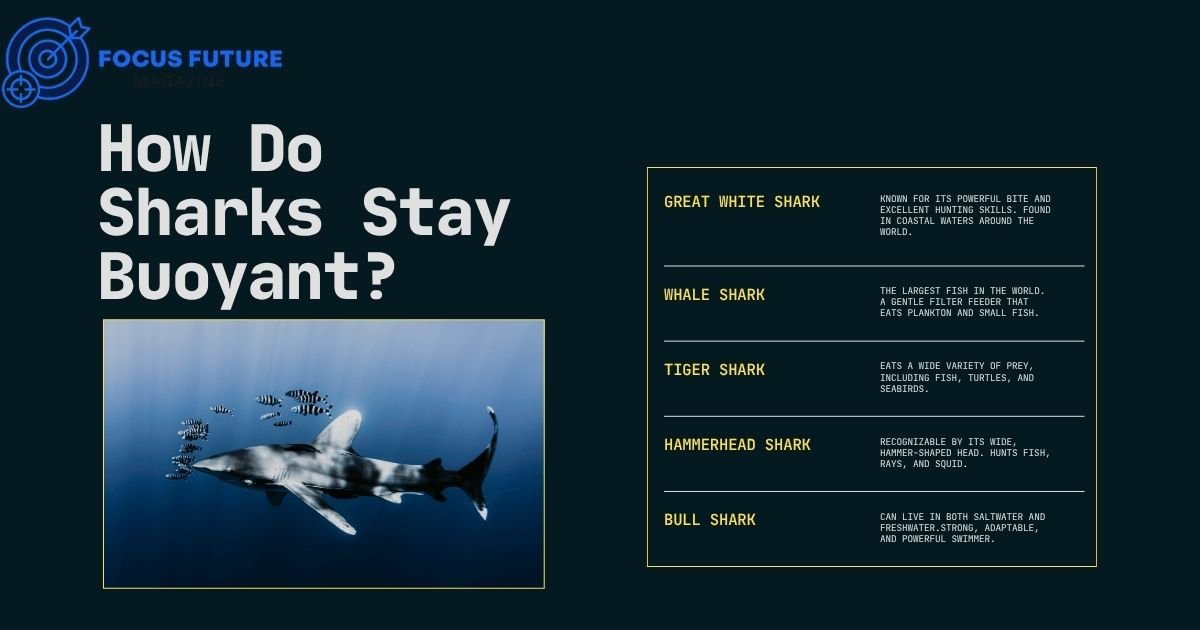
Sharks stay afloat with a mix of light cartilage, an oil-rich liver, fins, and swimming. Sharks lack a typical swim bladder, so they use other tools.
The liver holds low-density oils that add lift. The fins create dynamic lift as the shark moves forward. Some species, such as the sand tiger shark, also gulp air into the stomach for extra buoyancy.
Buoyancy is not just about liver oil. It is a system, and it differs from species to species.
How Do Sharks Find Prey?
Sharks find prey by layering several senses, each useful at a different distance. NOAA’s recent educational material lists eight shark senses: hearing, smell, vision, touch, taste, vibration or pressure detection, electroreception, and magnetoreception.
Here is how they often work together:
- Smell picks up chemical traces from far away.
- Hearing detects low-frequency sounds.
- The lateral line senses water movement, pressure, and vibration.
- Electroreception finds nearby electrical fields.
- Vision and touch help at close range.
Smell and Vision
Sharks have an excellent sense of smell. But the claim that they can smell one drop of blood from miles away is not a reliable general fact. Vision helps them hunt in low light, though it varies by species and habitat.
Lateral Line and Electroreception
The lateral line works like “touch at a distance.” It helps sharks locate moving or struggling prey.
Electroreception uses the ampullae of Lorenzini, pores around the head and snout. They detect the weak electrical signals that muscles and nerves give off. This helps a shark find prey that is hidden or close by.
Magnetoreception
This is a separate sense from electroreception. A 2021 study gave experimental evidence that bonnethead sharks use Earth’s magnetic field as a map-like cue. That supports the idea that some sharks navigate long distances using magnetic signals.
How Do Sharks Regulate Their Bodies?
Sharks manage salt, water, and heat with special body systems. Two stand out.
Osmoregulation
Marine sharks use urea and TMAO (trimethylamine oxide) to keep their salt and water balance steady. This is a different strategy from most bony fish. Some species, like the bull shark, can also tolerate low-salinity water.
Regional Endothermy
Most sharks are ectothermic, so water temperature mostly sets their body temperature. Some, mainly mackerel sharks, keep key muscles and organs warmer. They do this through countercurrent heat exchange in blood vessels.
The reported warming above the surrounding water is up to about 10°C in shortfin makos, 14°C in white sharks, and 21°C in salmon sharks. A 2025 study found that shortfin makos show enhanced warming during repeated dives. That suggests this trait may boost performance and hunting.
So “warm-blooded” is too simple. “Regionally warm-bodied” is closer to the truth for a few species.
How Do Sharks Avoid Detection?
Sharks blend in using countershading and habitat-specific camouflage. Countershading means a dark back and a light belly. From above, the dark back merges with deep water. From below, the pale belly matches the bright surface.
Other sharks use body shape and pattern. Angel sharks are flat and ambush prey from the seafloor. Reef and bottom-dwelling sharks often have patterns that match sand or rock.
How Do Sharks Reproduce?
Sharks reproduce in three main ways: laying eggs, keeping eggs inside until they hatch, or giving live birth. Different species use different modes.
Egg-laying sharks leave protective egg cases. Live-bearing species develop young inside the mother, and some use placental or nonplacental forms. In some species, embryos eat unfertilized eggs, a strategy called oophagy. In a few, embryos may eat siblings.
Not all sharks give birth to live young. And this matters for conservation, as you will see below.
What Adaptations Do Different Sharks Have?
Each shark’s adaptations match its niche. Sharks are not one uniform type.
| Species | Specialized adaptation |
| Great white (Carcharodon carcharias) | Serrated teeth, regional endothermy, countershading |
| Shortfin mako (Isurus oxyrinchus) | Streamlined body built for speed, regional endothermy |
| Hammerhead (family Sphyrnidae) | Wide head for sensory coverage and prey detection |
| Whale shark (Rhincodon typus) | Large mouth and filter-feeding structures |
| Basking shark (Cetorhinus maximus) | Gill rakers; filters roughly 2,000 tons of seawater per hour |
| Goblin shark (Mitsukurina owstoni) | Protrusible jaws for deep-sea prey |
| Cookiecutter shark (Isistius brasiliensis) | Glowing underside and a circular cutting bite |
| Angel shark (family Squatinidae) | Flat body and ambush camouflage |
| Bull shark (Carcharhinus leucas) | Tolerance for low-salinity water |
| Greenland shark (Somniosus microcephalus) | Cold-water physiology, slow metabolism, scavenging |
How Do Shark Adaptations Compare With Bony Fish?
The biggest differences are in the skeleton, skin, gills, and buoyancy.
| Feature | Sharks | Most bony fish |
| Skeleton | Cartilage | Bone |
| Buoyancy | Liver oil, fins, swimming | Often a swim bladder |
| Skin | Dermal denticles | Scales with a different structure |
| Gills | Multiple exposed slits in most species | Usually one covered opening per side |
| Teeth | Often continuously replaced | Replacement patterns vary |
| Salt balance | Urea-based strategy | Different systems |
Do Shark Adaptations Protect Them From Extinction?
No. Adaptations help sharks in nature, but they cannot beat rapid human pressure. Overfishing, bycatch, habitat loss, pollution, climate change, and illegal trade all move faster than evolution.
The 2024 IUCN global assessment involved 353 experts from 115 countries. It found that about 37% of sharks, rays, and chimaeras are threatened with extinction. Overfishing is the main cause. Note that this figure covers sharks, rays, and chimaeras together, not sharks alone.
Some adaptations even add risk. Slow growth, late maturity, and low reproduction make it hard for populations to recover from heavy fishing. Smithsonian’s summary also cites roughly 100 million sharks killed each year, but that is an estimate, not a direct count.
What Are Common Shark Adaptation Myths?
Many popular “facts” about sharks are oversimplified or wrong.
- Sharks must always swim. False. Some can pump water over their gills while still.
- All sharks are warm-blooded. False. Most are ectothermic, and only some have regional endothermy.
- All sharks are apex predators. False. Many are scavengers, filter feeders, or bottom feeders.
- All sharks have the same teeth. False. Shape follows diet.
- Sharks can smell one drop of blood from miles away. Not reliable as a general fact.
- Sharks have not evolved. False. Sharks have changed over time and keep adapting.
FAQs
What are the main shark adaptations?
The main ones are a cartilage skeleton, a streamlined body, dermal denticles, replaceable teeth, gills, strong senses, an oil-rich liver, countershading, and varied reproduction.
How do sharks stay buoyant?
They combine light cartilage, an oil-rich liver, lift from the fins, and swimming. Some species also gulp air into the stomach.
How do sharks breathe?
Water passes over the gills, where oxygen enters the blood. Sharks use ram ventilation, buccal pumping, or spiracles depending on the species.
How do sharks find prey?
They use smell, hearing, the lateral line, electroreception, vision, and touch. Each sense works best at a different distance.
Why is shark skin rough?
It is covered in dermal denticles, tiny tooth-like scales. They reduce drag and protect the skin.
Do sharks have bones?
Their main skeleton is cartilage. Teeth and some structures may contain mineralized tissue.
Are sharks warm-blooded?
Most are not. Some, like makos and great whites, keep key muscles and organs warmer through regional endothermy.
Do sharks lay eggs?
Some do. Others keep eggs inside until they hatch, and others give live birth.
How do shark adaptations vary by species?
Body shape, diet, senses, and movement all differ. A fast mako, a flat angel shark, a filter-feeding whale shark, and a deep-sea goblin shark each fit a different niche.