
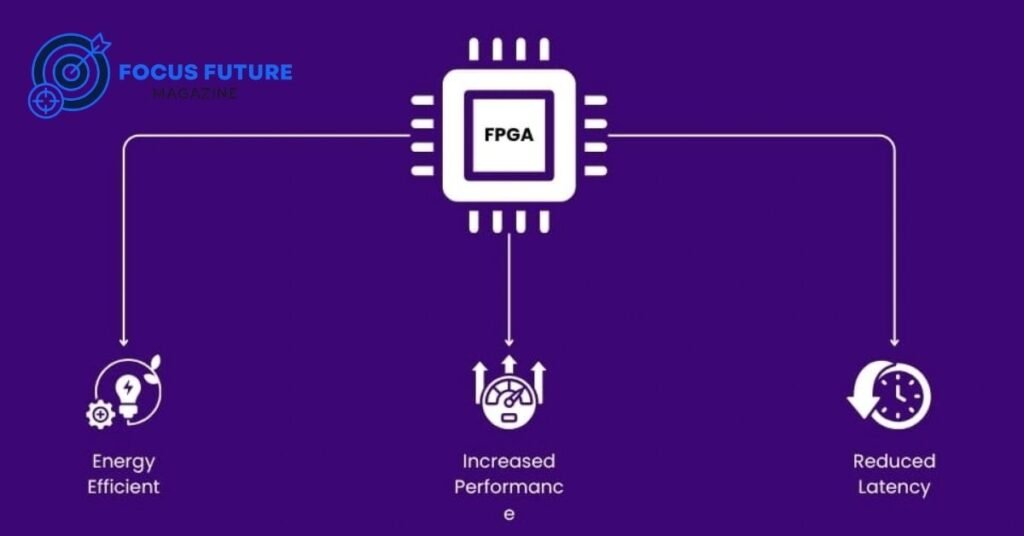
The main benefits of FPGA for low latency trading are nanosecond-scale execution, deterministic performance, and hardware-level parallel processing that software simply cannot match. Trading firms that adopt FPGAs cut their tick-to-trade latency from the microsecond range down to 100–500 nanoseconds, giving them a real edge in markets where speed decides who gets filled first.
If you are a CTO deciding whether to fund a multi-million dollar FPGA build, a quant trying to understand why competitors are faster, or an engineer curious about the technology, this guide breaks down exactly how FPGAs work in trading, what they cost, and when they are worth it.
Understanding FPGA in Trading Context
An FPGA, or Field-Programmable Gate Array, is a reconfigurable chip that lets a trading firm build its logic directly into hardware instead of running it as software on a CPU. Once market data hits the network card, the FPGA can parse it, update the order book, run risk checks, and send an order — all without ever touching an operating system.
This is the core reason the benefits of FPGA for low latency trading matter so much in high-frequency trading. A CPU has to move data through the kernel, through system calls, and through several layers of software before a decision gets made. An FPGA skips all of that. The logic lives in silicon, so there is no scheduler, no context switch, and no cache miss slowing things down.
Firms that use FPGAs typically deploy them at the edge of their network, often directly on a network card or “SmartNIC,” so the very first piece of hardware that sees the market data packet is also the piece that can react to it.
Why Low Latency Matters in High-Frequency Trading
In high-frequency trading, profit windows can close in a matter of nanoseconds. When a price moves, the firm that reacts fastest usually captures the opportunity, while everyone else adjusts to a price that has already changed. This is why speed is not a nice-to-have in HFT — it is the business model.
Because of this, the benefits of FPGA for low latency trading go beyond simple bragging rights about speed. They translate directly into filled orders, captured spreads, and avoided losses from stale quotes. A firm running on software alone, with 10–50 microsecond tick-to-trade times, is effectively trading blind compared to a rival running 100–500 nanosecond FPGA logic.
This gap has only grown more important as more firms adopt hardware acceleration, making it harder for software-only shops to compete on pure speed.
Core Benefits of FPGA for Trading
Ultra-Low Latency Execution
The clearest benefit is raw speed. FPGA-based tick-to-trade latency runs between 100 and 500 nanoseconds, compared to 10–50 microseconds for software running on a CPU. That is a 20–100x improvement, and for specific tasks like protocol decoding, FPGAs can be up to 1,000x faster.
This speed comes from processing data the instant it arrives, instead of waiting for it to move through an operating system’s network stack.
Deterministic Performance and Low Jitter
Speed alone is not the full story. One of the most underrated benefits of FPGA for low latency trading is determinism — the ability to deliver the same latency every single time, not just on average.
CPUs suffer from “long-tail” latency spikes during busy periods, where the 99th percentile (p99) latency can be far worse than the median. FPGAs process instructions in fixed clock cycles, so their p99 latency stays nearly identical to their median latency. For risk management and strategy design, this predictability often matters more than raw average speed.
Massive Parallel Processing
FPGAs are not limited to a handful of processor cores like a CPU. They can run many operations at the same time across custom-built hardware pipelines. A single FPGA can parse market data, update the order book, and run a pre-trade risk check simultaneously, rather than one after another.
This parallelism is a major reason FPGA trading systems can complete an entire tick-to-trade cycle in under a microsecond.
I/O and Network Offload
FPGAs can handle hardware timestamping using protocols like PTP/1588, decode exchange protocols such as ITCH or FAST at line rate, and even offload TCP processing — all before data reaches a general-purpose processor.
This “inline processing” approach means the FPGA is acting as the very first stage of the trading pipeline, catching and reacting to data at wire speed.
CPU and GPU Workload Offload
By handling the latency-critical parts of the pipeline, FPGAs free up CPUs and GPUs to focus on what they do best. CPUs can run strategy orchestration and analytics, while GPUs handle machine-learning inference workloads. The FPGA takes care of the sub-microsecond execution path.
This division of labor is one of the practical benefits of FPGA for low latency trading that shows up in real production systems: a hybrid CPU-FPGA-GPU architecture, with each chip doing the job it is best suited for.
FPGA vs CPU vs GPU: Which Is Best for Trading?
There is no single winner here — each chip has a role, and understanding where FPGAs fit is central to grasping the benefits of FPGA for low latency trading.
| Dimension | FPGA | CPU | GPU |
|---|---|---|---|
| Tick-to-trade latency | 100–500 ns | 10–50 µs | 2–15 µs |
| Determinism | Cycle-accurate, p99 ≈ p50 | Variable, long-tail spikes | Variable, scheduler uncertainty |
| Parallelism | Massive, custom pipelines | Limited cores (8–64) | Thousands of small cores |
| Power efficiency | High (task-specific) | Moderate | Lower (high throughput) |
| Flexibility | Reconfigurable (hours) | High (seconds) | High (seconds) |
| Best use case | Ultra-low latency execution | Strategy logic, orchestration | ML inference throughput |
| Infrastructure cost | $5.35M+ build, $4.59M/year | $40K–$400K | $100K–$500K |
Latency Comparison
FPGAs win decisively on raw speed and worst-case latency. GPUs sit in the middle, useful for machine-learning inference but not fast enough for tick-to-trade execution. CPUs are the slowest of the three but remain essential for flexible strategy logic.
Determinism and Predictability
This is where the benefits of FPGA for low latency trading really separate it from GPUs. A GPU’s scheduler introduces uncertainty, while an FPGA’s fixed hardware pipeline behaves the same way every time it runs.
Power Efficiency and Cost
FPGAs are more power-efficient than GPUs for equivalent tasks, which matters in co-location facilities with strict power budgets. However, they come with a much higher upfront development cost.
Flexibility and Development Complexity
CPUs and GPUs can be reprogrammed in seconds with new software. FPGAs need firmware updates, which can take hours, and require specialized Verilog or VHDL engineers rather than general software developers.
Trading Strategies That Benefit Most from FPGA
Not every strategy needs nanosecond speed. Knowing where the benefits of FPGA for low latency trading actually apply helps firms avoid wasting money on hardware they don’t need.
| Strategy | FPGA Suitability | Typical Latency Budget |
|---|---|---|
| Market making | Excellent | Under 500 ns |
| Latency arbitrage | Excellent | Under 1 µs |
| Statistical arbitrage | Good | 1–10 µs |
| Cross-venue hedging | Good | Under 5 µs |
| ML inference (simple models) | Good | 250 ns–2 µs |
| ML inference (transformers/LLMs) | Poor | Over 10 µs |
| Portfolio rebalancing | Poor | Over 1 ms |
Market Making and Spread Capture
Market makers post bid and ask quotes continuously and profit from the spread. Since they need to update quotes the instant the market moves, sub-microsecond FPGA execution is one of the clearest benefits of FPGA for low latency trading in this strategy.
Latency Arbitrage
This strategy exploits tiny price differences between venues before they disappear. Speed is the entire strategy here, so FPGA deployment is almost always worth the investment.
Statistical Arbitrage on Tick Data
Statistical arbitrage models react to patterns in tick data. FPGA acceleration helps, though the latency budget is a bit more forgiving than pure arbitrage.
Cross-Venue Hedging
Firms hedging positions across multiple exchanges need fast, coordinated execution. FPGA-driven order generation keeps hedges aligned even when prices move quickly.
ML Inference on FPGA
Machine learning is now entering the low-latency world. Myrtle.ai’s VOLLO product achieved 2 microseconds (99th percentile) latency for ML inference in financial trading, and Intel Stratix 10 FPGAs reach 250-nanosecond latency for simpler models. Large transformer-based models remain too slow for live execution, so most firms still use GPUs for heavier ML workloads.
Real-World Latency Statistics and Benchmarks
Numbers make the benefits of FPGA for low latency trading concrete. Here are the figures decision-makers actually use:
- FPGA tick-to-trade latency: 100–500 nanoseconds
- CPU tick-to-trade latency: 10–50 microseconds
- Speed improvement: 20–100x, up to 1,000x for specific tasks
- FPGA ITCH parser latency: under 25 nanoseconds
- FPGA ITCH parser throughput: 150,000 orders per second
- Well-optimized round-trip latency: around 1 microsecond with near-zero jitter
- ML inference record (Myrtle.ai VOLLO): 2 microseconds at p99
Tick-to-Trade Latency: FPGA vs CPU
The 20–100x gap between FPGA and CPU tick-to-trade latency is the headline statistic most firms cite when justifying investment.
p99 Latency and Tail Risk
Average latency hides risk. What matters is the worst-case scenario — and FPGA’s p99 latency staying close to its median is arguably one of the most valuable, least discussed benefits of FPGA for low latency trading.
ML Inference Latency Records
The 2-microsecond VOLLO benchmark, audited by STAC in April 2026, shows FPGAs are starting to compete with GPUs even for select machine-learning workloads.
Cost and Time-to-Market Analysis
Understanding cost is essential before chasing the benefits of FPGA for low latency trading, because the price tag is significant.
| Factor | Build In-House | Buy (Vendor, e.g. Exegy) |
|---|---|---|
| First feed handler cost | $5.35 million | $1.8 million annually |
| Per additional venue | $261,000 | Included in subscription |
| Time to first production | 3.5 years | 6 months |
| Full coverage (18 markets) | 6.5 years, $9.8M | ~20 months, $1.8M/year |
| Annual maintenance | $4.59 million | Included |
| Engineering headcount | 4+ specialized engineers | Minimal |
Build vs Buy: Total Cost of Ownership
Building the first in-house FPGA feed handler costs approximately $5.35 million, with $261,000 per additional venue. Full North American equities coverage across 18 markets totals close to $9.8 million — over five times more expensive than a vendor solution like Exegy, which runs about $1.8 million annually for the same coverage.
Development Time: In-House vs Vendor
Internal teams need 3.5 years to produce a production-ready FPGA feed handler, compared to about 6 months with a vendor — roughly six times faster. Each additional venue adds another 8–12 months in-house.
Engineering Headcount and Maintenance Costs
Building in-house requires at least four specialized FPGA engineers and about $4.59 million a year in ongoing maintenance — roughly double what a managed vendor service costs.
Common Mistakes and Failure Modes to Avoid
Even firms that understand the benefits of FPGA for low latency trading can lose money by implementing it poorly. Seven failure modes come up repeatedly:
- Benchmark vs production stack mismatch — buying hardware based on a vendor demo that doesn’t reflect real production traffic.
- Wrong architecture for workload — choosing inline versus co-processor design incorrectly, which looks similar on paper but costs microseconds per decision live.
- Ignoring host-side bottlenecks — a fast FPGA doesn’t fix a slow, un-audited strategy kernel on the CPU side.
- Firmware change management gaps — assuming hardware updates work like software deploys, when patch cycles are measured in hours, not seconds.
- Skipping software alternatives — never pricing out optimized software (like kernel-bypass networking) as a cheaper comparison point.
- Treating topology as a hardware upgrade — network topology, like cable length and switch placement, is a separate lever from silicon speed.
- Skipping cost-per-fill math — never connecting the $5.35 million price tag to how many fills per year are needed to break even.
Implementation Best Practices
Hybrid CPU-FPGA-GPU Architecture
Most successful deployments don’t rely on FPGA alone. They use FPGA for deterministic execution, GPU for machine-learning inference, and CPU for strategy orchestration — capturing the benefits of FPGA for low latency trading without forcing every task onto hardware that isn’t suited for it.
Vendor Selection and Evaluation
| Vendor | Product | Latency | Target Market |
|---|---|---|---|
| AMD/Xilinx | Alveo UL3524 | Under 500 ns | HFT, market data |
| Intel | Stratix 10 | 250 ns (simple ML) | Financial ML |
| Exegy | Managed feed handler | Vendor-specific | Buy-side firms |
| Solarflare | X2522/XL710 | Around 100 ns | Low-latency networking |
| Mellanox | ConnectX-6/7 | Around 150 ns | HFT, data centers |
Compare latency benchmarks, total cost of ownership, and vendor track record in financial services before committing.
Simulation, Debugging, and Testing
FPGA bugs are harder to trace than software bugs. Investing in simulation, waveform viewers, lint tools, and formal verification for critical paths like the order book and risk checks pays off long before production.
Regulatory Compliance and Risk Controls
Pre-trade risk checks — price collars, fat-finger protection, and maximum order rate limits — can be built directly into FPGA hardware, running at fixed latency. Combined with hardware timestamping for audit trails, this helps firms meet requirements under MiFID II, DORA, and SEC rules.
When Is FPGA NOT Worth It for Trading?
Not every firm needs to chase the benefits of FPGA for low latency trading. FPGA investment usually doesn’t make sense when:
- Strategies have latency budgets over 1 millisecond, such as portfolio rebalancing
- Trading volumes are too low to amortize a multi-million dollar build
- The firm lacks in-house FPGA expertise and cannot access vendor support
- Optimized software, like kernel-bypass networking, already meets latency needs
In these cases, the cost and complexity of building custom hardware outweigh the speed gained.
Latest Trends and Updates (2025–2026)
The FPGA landscape is evolving quickly. Recent developments show where the benefits of FPGA for low latency trading are heading next:
- December 2025: GPU-accelerated trading became standard for machine-learning inference workloads using H100/L40S deployments, while FPGAs stayed dominant for deterministic ultra-low latency execution.
- April 17, 2026: Analyst Ariel Silahian published a detailed breakdown of the seven FPGA infrastructure failure modes that cost firms more than the hardware itself.
- April 29, 2026: Myrtle.ai’s VOLLO product hit 2 microseconds at p99 latency for ML inference, audited by STAC at its London summit, halving the previous benchmark record.
- 2026: The industry standardized around processing market data and triggering orders directly on the network card, bypassing the server entirely.
- 2026: The EU’s Digital Operational Resilience Act (DORA) began shaping architectural resilience requirements that influence how firms design FPGA-based risk controls.
Frequently Asked Questions
What is an FPGA and how is it used in trading? An FPGA is a reconfigurable chip that lets trading firms run their logic directly in hardware. It processes market data, maintains order books, runs risk checks, and generates orders at hardware speed.
How much faster is FPGA than CPU for trading? FPGA tick-to-trade latency runs 100–500 nanoseconds versus 10–50 microseconds for CPU-based systems — a 20–100x improvement, and up to 1,000x for specific tasks like protocol decoding.
What are the main benefits of FPGA for low latency trading? The core benefits of FPGA for low latency trading are nanosecond-scale execution, deterministic p99 latency, parallel processing of market data and risk checks, and offloading I/O work from CPUs and GPUs.
Which trading strategies benefit most from FPGA? Market making and latency arbitrage benefit the most, since both require sub-microsecond, predictable execution. Statistical arbitrage and cross-venue hedging also benefit, though with slightly larger latency budgets.
How much does FPGA trading infrastructure cost? Building the first in-house feed handler costs about $5.35 million, with $261,000 per additional venue. Full North American coverage costs close to $9.8 million to build versus about $1.8 million annually through a vendor.
Should I build or buy FPGA trading infrastructure? For most firms, buying is the smarter choice unless they have unique requirements, deep in-house FPGA expertise, and high enough trading volume to amortize the multi-million dollar build cost.
What are the disadvantages of FPGA for trading? High development cost, long time-to-market (3.5 years versus 6 months for vendors), scarce Verilog/VHDL talent, harder debugging, and inflexible firmware update cycles measured in hours rather than seconds.
Can FPGA run machine learning models for trading? Yes, for simpler models. Myrtle.ai’s VOLLO reached 2 microseconds at p99 latency, and Intel Stratix 10 FPGAs hit 250 nanoseconds for basic models. Large transformer models are still too slow for live execution.
Conclusion
The benefits of FPGA for low latency trading come down to three things: speed measured in nanoseconds, predictable performance even under load, and the ability to run market data parsing, order book updates, and risk checks all at once in hardware. For strategies like market making and latency arbitrage, this translates directly into captured spreads and avoided losses.
That said, these benefits come at a real cost — millions of dollars and years of development if built in-house. Firms weighing this decision should look closely at their trading volume, in-house expertise, and strategy latency budgets before committing. For many, a vendor solution or a hybrid CPU-FPGA-GPU architecture delivers most of the benefits of FPGA for low latency trading without the full cost of building from scratch.
1 thought on “What Are the Benefits of FPGA for Low Latency Trading?”
Pingback: Extract Executive Contact Info From a Website (2026)