
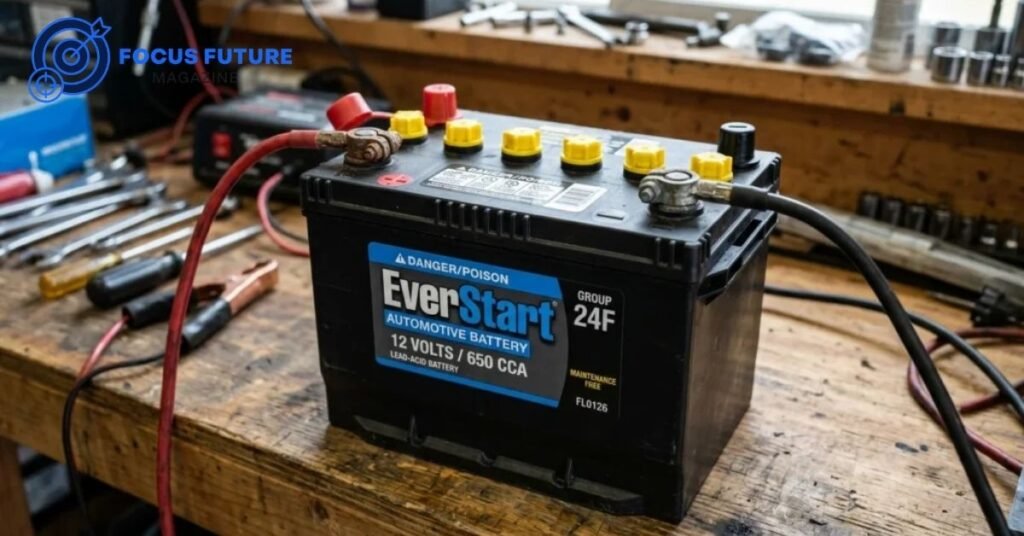
A 24 volt battery is a power source built to deliver roughly 24 volts DC, and it’s the go-to choice for equipment that needs more punch than a standard 12V setup — think RVs, boats, forklifts, and solar power banks. Whether you’re upgrading an electrical system or just trying to figure out which battery fits your project, this guide breaks down everything you need to know about a 24 volt battery, from chemistry and charging to cost and troubleshooting.
What Is a 24 Volt Battery?
A 24 volt battery is an energy storage device designed to output approximately 24 volts DC, though the exact number depends on the chemistry inside it. Lead-acid versions — flooded, AGM, or gel — sit at a true 24V nominal, usually built from two 12V batteries wired in series or packaged as a single 24V unit. Lithium versions run a bit higher: a LiFePO4 24 volt battery has a nominal voltage of 25.6V (eight cells at 3.2V each) and charges up to about 29.2V, while lithium-ion (NMC) packs land around 25.2V nominal.
You can build a 24V system in two ways — buy a purpose-made 24 volt battery, or wire two 12V batteries together in series. Both approaches work, but a single 24V lithium pack usually offers better balance, lighter weight, and simpler wiring than stacking two separate 12V units.
Why People Search for a 24 Volt Battery
Most people look into a 24 volt battery for one of these reasons:
- Equipment requirements — forklifts, trolling motors, mobility scooters, and commercial trucks need 24V for adequate torque and runtime.
- System upgrades — RV and marine owners often move from 12V to 24V to cut current draw and support bigger inverters.
- Solar storage — off-grid and backup power setups use 24V battery banks for moderate energy needs, typically in the 1–5 kWh range.
- Cost comparisons — buyers want to know whether 24V lithium is worth it over lead-acid for total cost of ownership.
- Troubleshooting — existing 24V systems sometimes develop charging issues, voltage sag, or outright failures that need diagnosing.
24V vs. 12V vs. 48V: Which System Is Right for You?
The right voltage depends on how much power you’re pulling. A 24 volt battery cuts current draw in half compared to a 12V system carrying the same load, which means smaller wire gauges and less voltage drop over distance. For a 2,000W load, a 12V system draws about 167A, while a 24V system only pulls 83A — a 48V system would draw just 42A.
| Factor | 12V System | 24V System | 48V System |
|---|---|---|---|
| Current draw (2,000W load) | 167A | 83A | 42A |
| Wire gauge required | 2/0 AWG | 2 AWG | 6 AWG |
| Inverter efficiency | 85–90% | 90–94% | 94–96% |
| Ideal power range | Under 1,000W | 1,000–2,000W | Over 3,000W |
| Common use | Small RVs, boats, vans | Medium RVs, boats, solar, forklifts | Large homes, commercial, grid-tied |
As a rule of thumb: pick 12V for small loads under 1,000W, choose a 24 volt battery for medium loads between 1,000–2,000W, and go 48V once you’re pushing past 3,000W or need to store more than 5 kWh.
Common Applications of 24V Batteries
A 24 volt battery shows up in a wide range of equipment because it hits a sweet spot between power and manageable wiring. Typical uses include:
- Electric forklifts and walkie pallet jacks
- Trolling motors for boats
- RV and camper house battery banks
- Marine electrical systems (house loads)
- Solar energy storage for off-grid and backup power
- Mobility scooters and electric wheelchairs
- Golf carts and low-speed electric vehicles
- Commercial trucks and heavy-duty vehicles
- Military vehicles and telecom backup power
- Robot lawn mowers and small electric boats
Heavy-duty trucks, buses, construction equipment, and some marine vessels rely on 24V electrical systems specifically for the higher starting power and reduced current draw they provide.
Types of 24V Batteries: LiFePO4, AGM, Gel, and Lead-Acid
Not every 24 volt battery is built the same way, and the chemistry inside changes almost everything — lifespan, weight, maintenance, and price.
| Parameter | LiFePO4 | AGM | Flooded Lead-Acid | Gel |
|---|---|---|---|---|
| Nominal voltage | 25.6V | 24V | 24V | 24V |
| Charging voltage | 29.2V | 28.8V | 28.8V | 28.4V |
| Cycle life (80% DoD) | 3,000–5,000+ | 200–300 | 200–300 | 200–300 |
| Usable capacity | 100% | 50% | 50% | 50% |
| Weight per kWh | ~10–12 kg | ~25–30 kg | ~25–30 kg | ~25–30 kg |
| Maintenance | None | None | Monthly water checks | None |
| Cost per kWh (2026) | $95–$140 | $150–$200 | $100–$150 | $180–$250 |
A LiFePO4 24 volt battery lasts six to ten times longer than a comparable lead-acid battery and gives you full access to its rated capacity, whereas AGM, gel, and flooded lead-acid batteries are generally limited to 50% depth of discharge for long-term health. Lead-acid still has a place — it’s cheaper upfront and handles vibration well — but a 24 volt lithium battery wins on total cost of ownership almost every time you cycle it daily.
24V Battery Specifications: Voltage, Capacity, and Cycle Life
When shopping for a 24 volt battery, three specs matter most: nominal voltage, amp-hour (Ah) capacity, and cycle life. A 24V 200Ah LiFePO4 battery stores 5.12 kWh (25.6V × 200Ah), enough to run a fridge, lights, and small electronics for a couple of days depending on usage.
Cycle life varies enormously by chemistry. A LiFePO4 24 volt battery can handle 3,000–5,000+ cycles at 80% depth of discharge, and up to 8,000+ cycles if you keep discharge shallower at 30%. Lead-acid and AGM batteries top out around 200–500 cycles under similar conditions, which is why they need replacing far more often.
How Long Does a 24V Battery Last?
A quality 24 volt lithium battery typically lasts 8–10+ years with daily cycling, thanks to its 3,000–5,000+ cycle rating at 80% depth of discharge. Lead-acid and AGM versions of a 24 volt battery generally last 3–5 years before capacity drops enough to warrant replacement, since they’re rated for only 200–500 cycles.
Calendar life matters too — a LiFePO4 24 volt battery holds up well even in storage, with a self-discharge rate of just 2–3% per month, compared to 5–10% per month for flooded lead-acid.
24V Battery Charging: Voltage, Chargers, and Best Practices
Getting the charging voltage right is the single biggest factor in how long a 24 volt battery lasts. Each chemistry needs a different charging profile, and using the wrong one can undercharge, overcharge, or trigger a battery management system (BMS) lockout.
| Battery Type | Absorption Voltage | Float Voltage | Equalization |
|---|---|---|---|
| LiFePO4 (8S) | 29.2V (±0.2V) | 27.6V (optional) | Not required |
| AGM | 28.8V (±0.2V) | 27.6V | Not recommended |
| Gel | 28.4V (±0.2V) | 27.6V | Not recommended |
| Flooded | 28.8V | 27.6V | 30–32V periodically |
What Voltage Should a 24V Battery Read?
A fully charged LiFePO4 24 volt battery should read close to 29.2V right after charging, settling to around 25.6–26V at rest. A fully charged AGM or gel 24 volt battery typically reads around 25.2–25.6V at rest. If your battery reads noticeably lower than these numbers, it may be discharged, sulfated, or nearing the end of its life.
How to Charge a 24V LiFePO4 Battery?
Use a dedicated LiFePO4-compatible charger set to 29.2V absorption. A charger between 20A and 100A works for most setups — a 50A charger will fully recharge a depleted 24V 200Ah battery in roughly four to five hours. Always match the charger’s output current to what the battery’s BMS can accept.
Can I Use a 12V Charger on a 24V Battery?
No. A 12V charger cannot supply enough voltage to properly charge a 24 volt battery. You need a charger specifically rated for 24V output, or an auto-detecting 12V/24V charger that’s compatible with your battery’s chemistry.
24V Battery Cost: Price Guide and Total Cost of Ownership
How Much Does a 24V Lithium Battery Cost?
In 2026, a 24 volt LiFePO4 battery pack in the 5–15 kWh range runs about $95–$140 per kWh FOB China. That puts a 24V 200Ah (5.12 kWh) battery at roughly $500–$750 depending on brand, BMS quality, and included features like Bluetooth monitoring or built-in heating. Note that lithium cell prices rose sharply in 2026 — more than double what they were at the start of 2025 — so prices have been trending upward.
Is 24V LiFePO4 Worth the Higher Upfront Cost?
Usually, yes. A 24 volt lithium battery costs more to buy but far less to own over time. A $600 LiFePO4 battery that lasts 10 years beats an AGM battery at $400 that needs replacing three or four times over the same period, pushing AGM’s real cost to $1,200–$1,600. Factor in the LiFePO4 battery’s 100% usable capacity versus AGM’s 50%, and the lithium option often works out 40–60% cheaper over a decade.
How to Choose the Right 24V Battery for Your Application
What Size 24V Battery Do I Need for RV, Boat, or Solar?
Start by adding up your daily energy use in watt-hours. For a LiFePO4 24 volt battery, size the pack to match your daily needs directly since you get 100% usable capacity. For lead-acid or AGM, double the capacity since only half is usable long-term. As a reference: an RV house bank for two people typically needs a 24V 200Ah (5.12 kWh) battery for two to three days of moderate use, while a trolling motor setup usually works well with a 24V 100Ah battery for four to six hours of runtime.
| Application | Recommended Capacity | Chemistry | Estimated Runtime |
|---|---|---|---|
| Trolling motor (55 lb thrust) | 24V 100Ah | LiFePO4 or AGM | 4–6 hours |
| RV house bank (2 people) | 24V 200Ah | LiFePO4 | 2–3 days |
| Solar storage (off-grid cabin) | 24V 200–400Ah | LiFePO4 | 1–3 days autonomy |
| Electric forklift (Class III) | 24V 200–500Ah | LiFePO4 | 6–8 hours/shift |
| Golf cart | 24V 150–250Ah | LiFePO4 | 18–36 holes |
24V Battery Installation: Wiring, Components, and Safety
How Do I Connect Two 12V Batteries to Make 24V?
To build a 24 volt battery bank from two 12V batteries, connect the positive terminal of the first battery to the negative terminal of the second (a series connection). The remaining free positive and negative terminals become your 24V output. Never connect positive to negative in parallel, since that creates a short circuit rather than a voltage increase.
What Wire Gauge Should I Use for 24V Systems?
Wire gauge depends on current draw and cable length, aiming for no more than a 3% voltage drop. For an 83A draw (a 2,000W load on a 24 volt battery) over a 10-foot run, 2 AWG copper wire is typical. Always check connections for tightness and corrosion, since loose wiring is a common cause of voltage drop complaints.
A complete 24V system generally needs: the battery bank, a compatible inverter, an MPPT solar charge controller (if applicable), a chemistry-matched charger, a battery monitor with shunt, a disconnect switch, and properly rated fuses or circuit breakers.
24V Battery Maintenance and Troubleshooting
How Do I Test a 24V Battery to Check Its Health?
Use a multimeter to check resting voltage — expect around 25.6V for a LiFePO4 24 volt battery or about 25.2V for AGM. Follow that with a load test: apply a known load and watch how much the voltage drops. A healthy battery should hold above 50% of its rated capacity under that load.
Why Is My 24V Battery Not Holding Charge?
For lead-acid versions, this is often sulfation — try an equalization charge at 30–32V to dissolve buildup. For a LiFePO4 24 volt battery, check individual cell voltages; if any cell reads below 2.5V, a slow charge at low current may help it recover. If capacity has dropped below 80% after 3,000+ cycles, replacement is usually the better fix.
How to Fix BMS Lockout on 24V LiFePO4?
If your 24 volt battery reads 0V output, the BMS has likely triggered a low-voltage cutoff. Check the resting voltage with a multimeter — if it’s under 20V, use a charger with recovery mode, or briefly apply an external 24V power supply to wake the BMS before switching to your normal charger.
What Are the Signs My 24V Battery Needs Replacement?
Watch for reduced runtime (under 80% of original capacity), rapid voltage drop under load, swelling or leaking, corroded terminals, repeated BMS fault codes, or a failed load test. Age matters too — expect 3–5 years from lead-acid and 10+ years from a well-maintained LiFePO4 24 volt battery.
24V Battery Safety and Certifications
Are 24V Lithium Batteries Safe?
Yes, as long as the pack includes a functioning battery management system that protects against overcharge, over-discharge, short circuits, and overheating. Look for a 24 volt battery certified to UL 1973, UL 9540, or IEC 62619 — these standards confirm the manufacturer has tested for common failure modes.
Can 24V Batteries Be Shipped by Air?
Small lithium packs under 100 Wh can be carried on without special approval. Batteries between 101–160 Wh need airline approval, limited to two spares per passenger. Most 24 volt battery packs exceed 160 Wh and must ship as cargo under hazmat rules, following UN 38.3 testing and proper labeling.
Best 24V Batteries for Specific Applications
Different jobs call for different priorities in a 24 volt battery. For trolling motors, LiFePO4 delivers consistent power output throughout the discharge cycle, unlike lead-acid, which sags as it drains. For forklifts, a LiFePO4 24 volt battery supports opportunity charging — quick top-ups during breaks — which can stretch a single battery across two or three shifts without swapping. For RVs, a 200Ah LiFePO4 pack covers a couple of days of moderate use for two people. For solar systems, pairing a 24 volt battery with an MPPT charge controller and matching panel voltage (30–40V) gets the most efficient charging.
24V Battery Performance in Different Conditions
How Does Temperature Affect 24V Battery Performance?
Cold weather is the biggest challenge for any 24 volt battery. A LiFePO4 pack’s BMS will typically block charging below 0°C (32°F) to protect the cells, though many models can still discharge down to -20°C. Lead-acid batteries handle cold differently — they’re less prone to charging cutoffs but can freeze if left in a deeply discharged state.
Can I Use 24V Batteries in Cold Weather?
Yes, but choose a 24 volt battery with a built-in heating pad if you’re regularly operating below freezing. The heating function activates before charging begins, protecting the cells from damage that occurs when lithium is charged cold.
24V Battery Recycling and Disposal
How Do I Recycle or Dispose of Old 24V Batteries?
Lead-acid batteries are about 99% recyclable — take them to an auto parts store or battery retailer rather than the trash. A lithium 24 volt battery should go to an e-waste recycler or a manufacturer take-back program, since improper disposal creates fire and environmental risks. Some manufacturers offer discounts on a new battery when you return the old one.
24V Battery FAQs
What is the nominal voltage of a 24V LiFePO4 battery? A LiFePO4 24 volt battery has a nominal voltage of 25.6V (eight cells in series at 3.2V each), charging to about 29.2V with a low-voltage cutoff near 20V.
How do I calculate runtime for my 24V battery? List your total daily loads in watt-hours, add a 20% buffer, then match that to a battery’s usable Wh. For LiFePO4, use 100% of rated capacity; for lead-acid or AGM, plan around 50% usable capacity.
Can I mix different 24V battery types or brands? It’s not recommended. Mixing chemistries, ages, or brands can cause imbalanced charging, reduced lifespan, and safety risks. Stick with identical batteries from the same manufacturer and batch.
Is 24V or 48V better for solar energy storage? A 24 volt battery works well for small to medium systems (1–5 kWh, 1,000–2,000W loads). Once you’re above 5 kWh or 3,000W, 48V becomes more efficient due to lower current draw.
Do 24V lithium batteries need a BMS? Yes, always. Every lithium 24 volt battery pack requires a battery management system to prevent overcharge, over-discharge, overcurrent, and cell imbalance — never operate one without a functioning BMS.
Conclusion
A 24 volt battery hits a practical middle ground for equipment and systems that outgrow 12V but don’t need the scale of 48V. Whether you’re powering a trolling motor, upgrading an RV, running a forklift, or building an off-grid solar bank, the chemistry you choose — LiFePO4, AGM, gel, or flooded lead-acid — will shape your upfront cost, maintenance workload, and how many years you get out of the battery. For most daily-use applications, a LiFePO4 24 volt battery pays for itself through longer cycle life and lower total cost of ownership, even though it costs more at checkout. Match the charger, wiring, and components to your battery’s chemistry, and a well-installed 24 volt battery system should run reliably for years.