
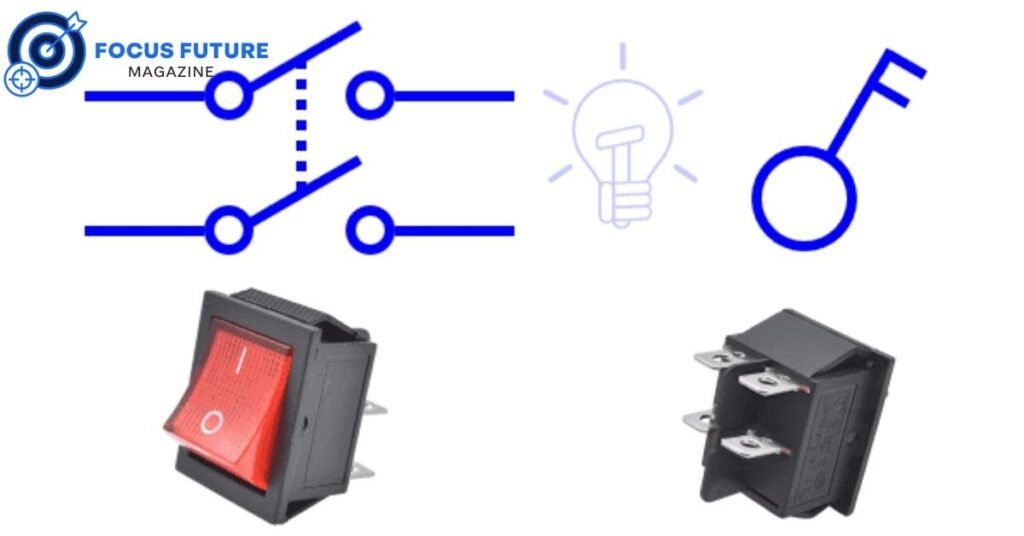
A DPST switch, or double pole single throw switch, controls two separate circuits at the same time with a single ON/OFF action. It has four terminals — two inputs and two outputs — and is most often used to fully disconnect both hot legs of a 240V circuit for safety.
If you’ve ever wondered how to shut off both wires feeding a water heater or HVAC unit at once, this type of switch is usually the answer. This guide covers how it works, how it compares to other switch types, how to wire it, and where it’s commonly used.
What Is a DPST Switch?
A DPST switch is an electrical switch that closes or opens two independent circuits simultaneously using one lever, toggle, or button. The name breaks down simply: “double pole” means it controls two circuits, and “single throw” means each pole only has one ON position — there’s no option to route power to a second output.
Think of it as two single pole single throw (SPST) switches joined by a shared mechanical linkage. When you flip the switch, both poles move together. You can’t turn one circuit on without the other.
Key characteristics:
- Controls two circuits at once (double pole)
- Only one ON/OFF position per pole (single throw)
- Four terminals total: two line (input) and two load (output)
- Functions like two SPST switches mechanically tied together
- Common in toggle, rocker, pushbutton, slide, and rotary designs
In wiring diagrams, it’s drawn as two parallel single-break symbols connected by a dashed line. That dashed line represents the mechanical linkage — the visual cue that both poles move together, not independently.
DPST Switch vs. Other Switch Types
The easiest way to understand this switch type is to compare it against the three switches it’s most often confused with: SPST, SPDT, and DPDT.
| Feature | SPST | SPDT | DPST | DPDT |
|---|---|---|---|---|
| Poles | 1 | 1 | 2 | 2 |
| Throws | 1 | 2 | 1 | 2 |
| Terminals | 2 | 3 | 4 | 6 |
| Circuits controlled | 1 | 1 (selects between 2 outputs) | 2 (simultaneous ON/OFF) | 2 (each selects between 2 outputs) |
| Typical use | Simple ON/OFF | 3-way lighting, signal routing | 240V isolation, dual-circuit ON/OFF | Motor reversal, source selection |
The pair people mix up most is DPST and DPDT. Both have two poles, but a DPST switch only turns each circuit on or off — it can’t route power to a second output. A DPDT switch has six terminals and can switch each circuit between two different outputs, which is why it’s used for things like reversing a motor’s direction or selecting between two power sources.
If your project only needs simultaneous ON/OFF control, the double-pole, single-throw design is the simpler, cheaper choice. If you need to redirect power or reverse polarity, you need a DPDT switch instead.
How Does a DPST Switch Work?
It works by physically linking two switching mechanisms so they move together. Inside the housing, the actuator — the toggle, rocker, or button you touch — connects to both sets of contacts through a shared shaft or lever.
When you flip it to ON, both poles close at the same instant, completing two circuits. When you flip it OFF, both poles open together, breaking both circuits. There’s no delay and no way to close one pole without the other, because they share the same mechanical action.
This is what makes a DPST switch so useful for safety disconnects. In a 240V split-phase system, power runs through two hot legs. A single-pole switch can only interrupt one of them, leaving the other leg live. This design interrupts both legs at once, so nothing downstream stays energized when it’s off.
Wiring a DPST Switch
Wiring one is straightforward once you understand the terminal layout. Each unit has four terminals, usually labeled L1 and L2 (line, or power in) and L3 and L4 (load, or power out).
Basic wiring steps for a 240V circuit:
- Turn off power at the breaker before touching any wires.
- Connect Hot 1 from the power source to terminal L1.
- Connect Hot 2 from the power source to terminal L2.
- Connect the load’s first wire to terminal L3.
- Connect the load’s second wire to terminal L4.
- Connect the ground wire directly to the equipment ground — never through the switch.
- Restore power and test both positions before closing up the enclosure.
For a 230V phase-and-neutral system (common outside North America), the same terminal layout applies, but one pole carries the phase wire and the other carries the neutral. This gives complete disconnection of both conductors rather than just the phase.
A common mistake is wiring only one hot leg and leaving the second hot leg connected directly to the load. This defeats the purpose of a DPST switch entirely, because one leg stays energized even when the switch is off. Always confirm both poles are wired before energizing the circuit.
Applications of DPST Switches
This switch type shows up anywhere two circuits need to be controlled together, especially in 240V systems. Here are the most common places you’ll find one.
| Application | Voltage | Why DPST |
|---|---|---|
| Electric water heater | 240V | Disconnects both hot lines for safety |
| HVAC safety disconnect | 240V | Required when the breaker isn’t within sight |
| Baseboard heater | 240V | Full isolation of both ungrounded conductors |
| Industrial motor | 240V/480V | Dual-line isolation during maintenance |
| Well pump | 240V | Safety disconnect at the point of use |
| Tankless water heater | 240V | Meets local disconnect code requirements |
| Dual-phase LED lighting | 230V/240V | Controls both phase and neutral |
| Smart home 220V system | 220V split-phase | Full disconnection for IoT safety |
Beyond residential wiring, it also appears in tube amplifier standby circuits, pressure switches, float switches, battery management systems, and medical equipment that requires dual-pole isolation for safety compliance.
Why Use a DPST Switch? (Safety Benefits)
The main reason to choose this design over a single-pole switch is complete power isolation. In any 240V circuit, both hot legs carry live voltage. If you only switch one leg, the other stays energized, which creates a real shock hazard during repairs or maintenance.
A DPST switch removes that risk by cutting both legs at the same time. This matters most for equipment like water heaters, HVAC units, and well pumps, where someone may need to work on the unit without shutting off the entire electrical panel.
Local electrical codes often require this kind of disconnect. In the U.S., the National Electrical Code calls for a visible, accessible disconnect near HVAC equipment and certain water heaters when the breaker panel isn’t within sight. A properly installed unit of this type usually satisfies that requirement.
DPST Switch Specifications and Ratings
Before buying one, match its ratings to your circuit. Using an underrated switch is one of the most common causes of overheating and premature failure.
| Rating Type | Typical Range | High-End Industrial |
|---|---|---|
| AC Voltage | 125V – 277V | Up to 440V (IEC 60669-2-4) |
| DC Voltage | 12V – 28V | Up to 800V |
| Current | 4A – 20A | 50A – 125A |
| Electrical Life | 10,000 – 50,000 cycles | Up to 100,000 cycles |
| IP Rating | IP20 – IP40 | IP65 – IP67 |
| Operating Temp | -25°C to +85°C | -40°C to +100°C |
Always choose a rating that covers at least the voltage and current of your circuit, and add extra headroom for motors or other inductive loads, which draw much higher current at startup than during normal running.
Types of DPST Switches
This category comes in several physical formats, each suited to different applications:
- Toggle switches – general purpose and industrial panels
- Rocker switches – consumer electronics and automotive use
- Pushbutton switches – emergency stops and industrial controls
- Slide switches – low-power PCB and electronics applications
- Rotary switches – multi-position panel controls
- Pressure switches – HVAC systems, pumps, and compressors
- Float switches – liquid level control in tanks and sumps
The internal mechanism stays the same across all of these — two linked poles, one throw — but the housing and actuator style change to fit the mounting location and how often it gets used.
DPST Switch Installation Guide
Installing one is a manageable task for someone comfortable with basic electrical work, but it still involves live household voltage, so caution matters.
- Shut off power at the breaker and confirm it’s off with a voltage tester.
- Choose a switch rated for your circuit’s voltage, current, and environment (indoor or outdoor).
- Strip wires to the length specified by the manufacturer.
- Connect line wires to the input terminals and load wires to the output terminals.
- Torque terminal screws to the manufacturer’s spec — usually 12 to 18 in-lbs for small switches.
- Mount the switch in an enclosure rated for its location.
- Restore power and test both ON and OFF positions before closing everything up.
If you’re unsure about local code requirements or working with anything above standard residential voltage, it’s worth calling a licensed electrician rather than guessing.
Troubleshooting DPST Switch Problems
A unit like this can fail in ways that aren’t always obvious, especially when one pole stops working before the other. Here’s how to check it.
Use a multimeter set to continuity mode. With the switch OFF, test across each pole separately — neither should show continuity. With it ON, both poles should show continuity. If one pole shows continuity when the switch is off, or the poles don’t move at the same time, the internal linkage has likely failed and the part needs to be replaced.
Common signs of failure include visible arcing, discoloration around the terminals, a loose or spongy feel when switching, or one circuit staying powered when it shouldn’t. Any of these are reasons to replace the switch rather than keep using it.
DPST Switch Code Requirements (NEC)
In the U.S., the National Electrical Code requires a local, visible disconnect for several types of equipment, and this switch type is a common way to meet that requirement. HVAC equipment generally needs a disconnect within sight of the unit unless it’s lockable. Electric water heaters and tankless heaters have similar local disconnect requirements in many jurisdictions.
Outside North America, IEC standards like IEC 60669-2-4:2024 cover manually operated isolating switches, including double-pole designs, for voltages up to 440V and currents up to 125A. If you’re installing one as a required disconnect, check your local code before finalizing the installation, since requirements vary by region and equipment type.
Smart DPST Switches for Home Automation
Standard smart switches are usually single-pole, which is a problem for 220V/240V split-phase systems — they can’t fully disconnect both live conductors. Newer smart versions solve this by combining IoT control with true double-pole disconnection, so you get remote access without giving up complete isolation.
These smart double-pole switches are gaining traction as more homes push for full automation on higher-voltage circuits. Before buying one, confirm it’s genuinely rated for double-pole disconnection and check compatibility with your existing home automation platform, since not every brand supports every hub.
Frequently Asked Questions About DPST Switches
What does DPST stand for? DPST stands for Double Pole Single Throw. It describes a switch that controls two separate circuits (double pole) with only one ON/OFF position per circuit (single throw).
How many terminals does it have? Four terminals — two input (line) terminals and two output (load) terminals.
Can it be used for 240V circuits? Yes. It’s commonly used for 240V circuits because it can disconnect both hot legs at the same time, giving complete isolation for safety.
What is the difference between DPST and DPDT? A DPST switch only turns two circuits on or off together. A DPDT switch has six terminals and can switch each circuit between two different outputs, which is needed for things like motor reversal.
Is it safer than an SPST switch? For 240V or split-phase circuits, yes. It disconnects both live conductors, while an SPST switch only disconnects one, leaving the other energized.
Can I use one instead of a DPDT switch? Only if you don’t need to switch between two different outputs. It can’t reverse polarity or select between power sources — for that, you need a DPDT switch.
What voltage and current ratings are typical? Common ratings run from 125V to 277V AC and 12V to 28V DC, with currents from 4A to 20A for standard units. Industrial versions can handle up to 800V DC or 125A.
What applications commonly use this switch? Electric water heaters, HVAC disconnects, baseboard heaters, industrial motors, well pumps, and dual-phase lighting are among the most common uses.
Common Mistakes to Avoid
- Wiring only one hot leg, leaving the second leg permanently energized
- Using this switch type when the application actually needs a DPDT switch
- Choosing a rating too low for the circuit
- Mixing up line and load terminal connections
- Skipping the ground connection
- Installing an indoor-rated unit in a wet or outdoor location
- Assuming it provides overcurrent protection, which it does not — that’s the breaker’s job
Expert Tips for Selection and Installation
- Test both poles independently with a multimeter before trusting the switch is fully functional.
- Choose a higher current rating for motors and other inductive loads, since they draw much more current at startup.
- Use consistent, color-coded wiring on both hot legs to make future troubleshooting easier.
- Install the disconnect within sight of the equipment it controls, as many codes require.
- Document your wiring with labels or photos in case you need to service it later.
- Inspect high-cycle units annually and plan to replace them every 5 to 10 years in critical applications.
Where to Buy a DPST Switch
These are widely available from online retailers like Amazon and eBay, as well as industrial suppliers such as McMaster-Carr and RS Components. Prices typically range from around $10 for basic toggle versions to $50 or more for industrial-rated or specialty options. Established manufacturers like Eaton, Hubbell, Leviton, TE Connectivity, and Square D are good starting points if you want a part backed by solid documentation and warranty support.
Conclusion
A DPST switch is a simple but essential tool for controlling two circuits with one action, and it’s especially valuable anywhere complete power isolation matters — water heaters, HVAC systems, motors, and other 240V equipment. Understanding the difference between it and its close relatives, SPST and DPDT, makes it much easier to pick the right part the first time.
Whether you’re wiring a new disconnect or replacing a failed unit, matching the voltage and current rating to your circuit, wiring both poles correctly, and following your local code will keep the installation safe and reliable for years.